

Cart
0

All the Music of the World Vol. 13 - Traveler's Note
* Release date and component specifications may be subject to change due to manufacturing reasons.* All products are non-refundable/exchangeable/returnable once...
Vendor: LogiShip-X
Type: ASIA
Sku: 8809090676599
Safe Packaging
Worldwide Shipping
Kpop
👀
customers are viewing this product
🔥 30 sold in last 18 hours
Guarantee safe checkout

All the Music of the World Vol. 13 - Traveler's Note
$13.30

* Release date and component specifications may be subject to change due to manufacturing reasons.
* All products are non-refundable/exchangeable/returnable once opened.
* In case of product defects or missing components, re-shipment/return/refund processing is only possible with a recorded video from the moment the delivery box is opened until the components are confirmed after opening the packaging.
* Please note that defects or missing components cannot be acknowledged without a recorded video.
* External damage occurring during shipping is non-refundable/exchangeable/returnable if the product's plastic wrapping has been opened or removed.
* Minor scratches, dents, and discoloration may occur on the exterior during product packaging/delivery, and these are not grounds for exchange.
* Random components included in this album are configured with equal probability.
During a time when travel had disappeared from daily life,
we realized anew how precious those days were when we could travel freely.
Now, travel is possible again, and I took out the <Traveler's Note> that I had put aside for a while,
and filled it page by page.
Thus, the journey that began in Oia village of Santorini
concluded in Finisterre, Spain, known as the 'End of the World'.
It was a pity, but everything comes to an end someday.
And travelers eventually return home too.
The 13th album created by <All the Music of the World> contains
memories and longing etched in the <Traveler's Note>.
Starting with a night in Naples, Southern Italy, it records a musical journey passing through Greece, Spain, Corsica, Mexico,
Portugal, Scotland, and reaching Northern Europe.
Therefore, a commentary booklet, like a music note written from a traveler's perspective,
was also prepared with special care.
To DJ Jeon Ki-hyun, who celebrates the 10th anniversary of hosting <All the Music of the World> this year,
and to writer Kim Mi-ra, who created the name <All the Music of the World> and breathed life into its growth over the past 23 years,
we send infinite affection and gratitude.
It has been a long time since digital music replaced CDs,
and we live in an era of ultra-high-speed AI where machines select music instead of humans, but
there are still things that can only be complete when we experience them ourselves.
The excitement of travel, mornings waking up in a new destination, and music heard while traveling
can only be complete through my own choices and experiences.
We hope that the 13th album prepared by <All the Music of the World>
will accompany you for a long time, flying through the sky with you, listening to the sound of waves together,
and being colored by the sunsets of unfamiliar lands.
KBS Classic FM <All the Music of the World> Producer Ahn Jong-ho
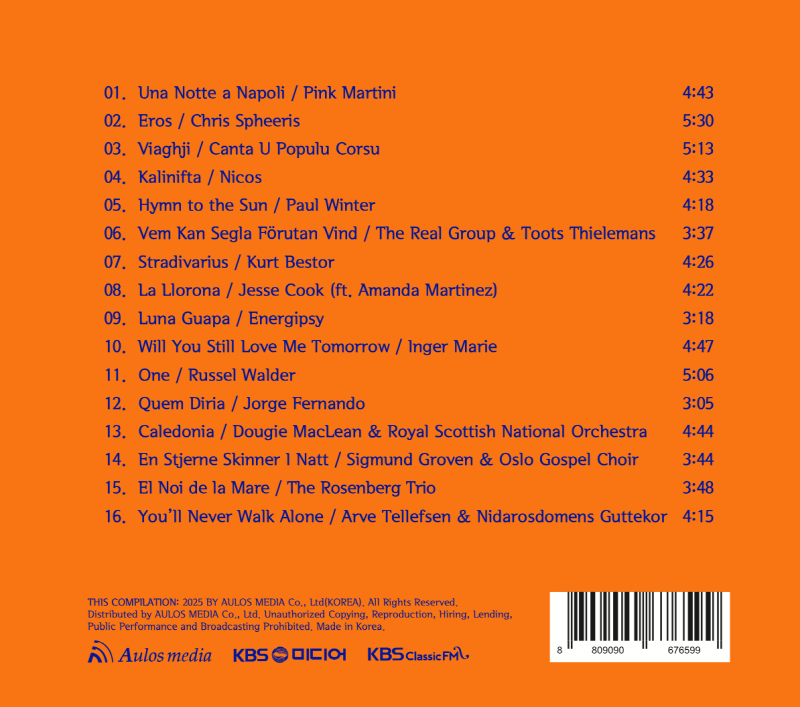
[Track Commentary]
01_ Una Notte a Napoli / Pink Martini
Darkness falls on Naples. Walking through the alleys around Dante Square, the historical district of Naples, bathed in golden light,
a traveler might encounter an angel with hidden wings.
‘Una Notte a Napoli’ is a story of love and farewell shared with an angel.
Pink Martini's unique elegance and cinematic storytelling stand out.
This song is a collaboration between Pink Martini's leader and pianist Thomas Lauderdale,
vocalist China Forbes, and Neapolitan artist Alba Clemente. 'A night in Naples, I met an angel by the moonlit sea. An angel who couldn't fly.'
Alba Clemente's lyrics, Pink Martini's performance, and China Forbes' voice combine
to paint a dreamy night in Naples.
Listening to 'Pink Martini' is about enjoying a 'world tour through music'.
This multinational band explores music from around the globe, traveling across languages and genres.
Music, love, travel, and Naples and angels!
‘Una Notte a Napoli’ is an elegant overture announcing the start of a journey.
02_ Eros / Chris Spheeris
‘Eros’ has an infinite number of faces. The philosopher Plato described 'Eros' as something beyond love,
a longing for beauty and truth. He defined 'Eros' as the journey of the soul ascending to a higher place, filling the desire born from lack.
Chris Spheeris's 'Eros' is like the rails laid out on that journey of the soul.
Chris Spheeris is a Greek who grew up in America, an essential traveler.
He travels the world and integrates unfamiliar cultures into his music.
His musical depth and individuality come from his travels. Chris Spheeris not only composed and played the guitar for 'Eros', but also played the keyboard, bouzouki, percussion, and even bass himself.
It can be said that he poured his entire being into this song.
Chris Spheeris's music has a warm and mysterious resonance.
‘Eros’ is the definitive work of that kind. If you were to meet Eros, who walked out of mythology,
it might feel like this. We set off on a journey, following Chris Spheeris's performance.
It could be a journey to a very distant place,
or perhaps a journey delving deep into the heart.
03_ Viaghji / Canta U Populu Corsu
Corsica, this small island floating in the Mediterranean, suffered trials and tribulations, belonging first to Greece, then Italy, then France.
Corsican traditional music was the soul's armor and a poignant weapon that protected the Corsican people through such hardships.
‘Canta U Populu Corsu’, meaning 'the Corsican people sing', is
a group that reinterprets Corsican traditional music in a modern way.
Petru Guelfucci, a representative Corsican musician, was also a member of this group.
‘Viaghji’ captures the charm of Canta U Populu Corsu, singing traditional Corsican polyphony in a more approachable style.
‘Viaghji’ means "travel" in Corsican. Most Corsican music gives a grand and
intense feeling, but Canta U Populu Corsu's ‘Viaghji’ creates a different kind of Corsican music with emotional lyrics and
a soft melody.
This song, included in the 1995 album (meaning 'emotions'),
contains the journey and longing of people who left their hometowns. To Corsicans,
it's like a letter from home, and to travelers, it's like an invitation from a Mediterranean resort.
04_ Kalinifta / Nicos
Greek musicians often describe their music as 'Mediterranean music'.
They share a sentiment that forms a larger entity than a nation: the 'Mediterranean'.
Mediterranean music, a blend of Greek, Italian, Turkish, Egyptian, and Balkan melodies and rhythms,
transcends borders and emotional boundaries, forming an emotional community.
Nicos's ‘Kalinifta’ is also Mediterranean music presented by a Greek performer.
‘Kalinifta’ means 'good night' in a Southern Italian dialect, and Nicos's electric violin is
the optimal instrument for expressing melodies that have leaped across time. When he starts playing,
wherever it is, it becomes a square in a small Italian town, a Turkish bazaar,
a Mediterranean beach, the rugged mountains of the Peloponnese, and the plains of the Balkans.
Melodies imbued with Mediterranean sentiment are fused with the electric violin, synthesizer, and unique orchestral accompaniment.
‘Kalinifta’ is not merely traditional music brought into the present, but
music that transcends time due to uncontrollable passion. Let's embark on a Mediterranean journey with Kalinifta.
Let's walk until we meet people with warm hearts, until we hear kind goodnight greetings.
05_ Hymn to the Sun* / Paul Winter
In the heart of New York lies the Cathedral of Saint John the Divine. Paul Winter described
this colossal Gothic cathedral as 'a living creature open to the sky'.
Inside this cathedral, a single note lingers for 7 seconds. The music created by that mysterious resonance,
‘Hymn to the Sun’, is the sunshine, prayer, and silence encountered in New York.
In 1982, Paul Winter recorded at this cathedral. 'Hymn to the Sun', included in this album,
was completed by Paul Winter and Paul Halley, and
is said to have been inspired by Bach's French Suites and cantatas.
Bach's melodies, the sunrise over the Grand Canyon, and light passing through the cathedral's stained glass
were etched onto the staff. ‘Hymn to the Sun’ is a sacred echo encountered in the heart of New York.
Paul Winter served as an artist-in-residence at the Cathedral of Saint John the Divine and
held the Winter Solstice Celebration every winter. In this annual performance, expressing life, cycles, the sublimity and
grandeur of nature through music, he incorporated the sounds of whales, wolves, and birds into his music.
He wove together the grandeur of nature, the lingering echoes created by sacred spaces, and
the human emotions that resonate with them, painting a holy picture.
‘Hymn to the Sun’ is the most brilliant fruit of that effort.
* This track includes the distinctive sound of the Bendir drum used in the recording.
Please note that this is not a recording issue or sound anomaly.
06_ Vem Kan Segla Förutan Vind / The Real Group & Toots Thielemans
Who can sail without wind! The Swedish folk song ‘Vem Kan Segla Förutan Vind’ is
a question unfurled like a sail in everyone's life. It contains the tender yet strong image of humanity within its gentle melody. This song, which tells us how we are connected and how we cherish and love each other,
has long comforted the hearts of Scandinavian people.
‘Vem Kan Segla Förutan Vind’ was a folk song from Åland, an autonomous region of Finland where Swedish is spoken, and was first published as sheet music in 1909.
Farewell to loved ones, the sea to navigate alone, and the wind like the hand of God.
Their voyage across the Baltic Sea is a journey for all of us.
The Real Group and Belgian harmonica player Toots Thielemans
breathed new life into this traditional folk song. The German poet Rainer Kunze, in his poem 'Two People', said:
'One knows the stars and one knows the storm.'
Toots Thielemans' harmonica twinkles as if it knows the stars,
and The Real Group's restrained harmonies are like voices comprehending the storm.
Who can sail without wind!
Beyond Scandinavia, beyond Sweden and the Baltic Sea, it is a question mark and an exclamation mark etched into everyone's life.
07_ Stradivarius / Kurt Bestor
In the streets of Cremona, Northern Italy, the sound of string instruments is always heard.
Like the Tuscan villages where the scent of wine lingers in the air, the air of Cremona
is mixed with the fragrance of violins. The violin sound, seemingly a hallucination,
informs us that this is the hometown of Antonio Stradivari.
Kurt Bestor's ‘Stradivarius’ was composed to honor
Antonio Stradivari, the master craftsman who created the finest violins. Included in his 1977 album , ‘Stradivarius’ reveals the extent of emotion that can be expressed by a violin.
It depicts Stradivari's craftsmanship and artistic spirit with outstanding performance and rich acoustics.
Kurt Bestor was born in Wisconsin and began his career as a New Age musician,
showing particular interest in film music. ‘Stradivarius’ is a work that clearly demonstrates his artistry and philosophy.
‘Stradivarius’, harmonizing Baroque elements with modern sensibilities,
features impressive delicate violin melodies and an immersive quality akin to watching a film.
Kurt Bestor's superb violin melodies instantly transport us to Cremona, Italy,
and to Baroque Venice, where Vivaldi walked in priestly robes.
08_ La Llorona / Jesse Cook (ft. Amanda Martinez)
Mexico is as intense as its orange sun.
Its laughter is deep, and its sorrow is like a long-simmered herbal medicine. So is the Mexican traditional folk song ‘La Llorona’.
‘La Llorona’, meaning ‘The Weeping Woman’ or ‘The Sobbing Woman’, is sung by every Mexican singer at least once, and it sings of a soul steeped in sorrow, having lost both love and children.
Jesse Cook's reinterpretation of ‘La Llorona’ with flamenco guitar is
deep and tender, as if to wipe away the tears of Mexican women. The flamenco guitar and
Amanda Martinez's profound voice combine to express the original song's deep-seated tears
as a lingering sadness.
Jesse Cook is a born traveler. Born in France and raised in Canada, he
studied music in the US and UK, and while traveling in Spain, France, and Latin America,
he incorporated the music of those regions into his own style. Listening to ‘La Llorona’ with Jesse Cook's flamenco guitar
is like a handkerchief wiping away the old tears of a Mexican woman.
09_ Luna Guapa / Energipsy
Walking through the narrow streets of Seville, you sometimes encounter gypsy musicians.
Passionate dances by gypsy dancers with red flowers in their hair unfold everywhere, accompanied by flamenco guitar.
Energipsy's ‘Luna Guapa’ – ‘Beautiful Moon’ –
brings to mind those alleys of Seville.
‘Luna Guapa’, a harmonious blend of flamenco rhythms, jazz freedom, and gypsy music passion, is a work that clearly shows Energipsy's identity.
It's a song that unleashes the fervor of flamenco and the delicacy of jazz under the beautiful moonlight, and
a romantic night story told by Energipsy.
Energipsy is a music project led by Italian guitarist Francesco Grant. This group, which fuses flamenco and jazz, pop and New Age music to create unique sounds, breathes new life into old and familiar things.
In addition to his work with Energipsy, Francesco Grant frequently performs solo, and
has collaborated with artists such as Gipsy Kings and José Feliciano. He is an alchemist who mixes Scottish heritage, Italian sensibility, and Spanish passion to achieve optimal results.
10_ Will You Still Love Me Tomorrow / Inger Marie
Jazz vocalist Inger Marie was born in Arendal, a small port city in Norway. The surprisingly large number of jazz musicians in Norway might be because the country's pace
aligns with jazz. Grand nature, sparsely scattered people,
slow steps, very long or very short nights. It's a truly wonderful place to enjoy jazz.
Inger Marie released her solo album ‘Make This Moment’ after 25 years of diverse band activities. Light as air, and mysterious like an evening curtain,
her voice transforms any familiar song into a new sensation.
‘Will You Still Love Me Tomorrow’ was first released in 1960 by the American female group ‘The Shirelles’.
Composed by Carole King and Gerry Goffin, ‘Will You Still Love Me Tomorrow’ has countless covers, but Inger Marie's interpretation is
undoubtedly superb. Gentle piano, restrained rhythm, and a mysterious voice convey delicate emotions. Can today's feelings overcome tomorrow's reality?
‘Will You Still Love Me Tomorrow’, a question lingering in a quiet jazz bar in Norway,
seems capable of spinning enough stories to make a whole movie.
11_ One / Russel Walder
Beauty always lies beyond boundaries.
Russel Walder, a jazz oboist and composer, always looks at that point.
He pursues freedom across genres and unleashes impromptu and pure emotions without limits.
Russel Walder's ‘One’ resembles the wind born from magnificent nature.
This song was included in his first album , released in 2002, and ‘Pure Joy’ is
the ideal he pursues through music. Russel Walder treats the classical instrument 'oboe'
like a traveler's instrument. His oboe playing is as free as the wind, and sometimes
he delivers a performance so grand it sounds like a whole orchestra, just with the oboe.
Why is the title of this song ‘One’? Russel Walder wants scattered people
to draw closer, to connect and heal each other.
Considering his excellence in improvisation, ‘One’ might signify a unique, absolute moment.
A single precious moment, or the wonder of becoming one.
Either way, Russel Walder's oboe melody will take us to nature, to loved ones,
to a time when we were most pure and happy.
12_ Quem Diria / Jorge Fernando
The benchmark for a Lisbon trip is taking tram 28 to the Alfama district and
listening to fado sung by a fadista. Or watching the evening lights of Lisbon turn on one by one
from a viewpoint on a hill at sunset.
Of course, even at that moment, fado will likely be heard from a corner of the viewpoint.
In Portugal, where female fadistas are dominant, Jorge Fernando is one of the rare and precious
male fadistas. He was born in Lisbon and grew up listening to traditional fado played by his grandfather from childhood.
After starting his musical career, he worked as a guitarist for Amália Rodrigues
and learned everything about fado.
With a keen interest in reinterpreting traditional fado in a modern way, he made notable contributions as a singer, composer, instrumentalist,
and producer.
‘Quem Diria’ means 'Who would have thought?'. Jorge Fernando
elegantly unravels the inherent beauty and fear of love. Listening to ‘Quem Diria’, one realizes that fado is not just about passionate sorrow and
lament. His efforts to create sophisticated and new fado without losing traditional fado are fully embodied in ‘Quem Diria’.
Now, when longing for Lisbon, Jorge Fernando's ‘Quem Diria’ might come to mind.
13_ Caledonia / Dougie MacLean & Royal Scottish National Orchestra
Climb Calton Hill in Edinburgh and look at the landscape spread out below.
Scotland's old name is Caledonia.
In Edinburgh, where green hills and historic stone buildings are in harmony,
travelers naturally recall Dougie MacLean's ‘Caledonia’.
Interestingly, this song was composed not in Scotland but on the beaches of Brittany, France, across the sea.
In 1977, Dougie MacLean was traveling through Europe with his Irish friends, busking, and it is said that he suddenly missed his homeland on the beach of Brittany
and composed this song. This song, composed with a yearning heart on a foreign beach,
was loved like Scotland's unofficial national anthem, perhaps because of its backstory.
Interwoven with layers of independence and solidarity, love and loss, homecoming and memories, this song is still loved across generations.
Dougie MacLean is an artist who performs traditional Scottish music with various instruments.
Although he left behind masterpieces like ‘The Gael’, he stated that the most truthful and meaningful song to him is
indeed ‘Caledonia’. It is a song deeply cherished by Scottish people, played at various events such as weddings and football matches.
14_ En Stjerne Skinner I Natt / Sigmund Groven & Oslo Gospel Choir
Many stars appear in the night sky of Oslo. Around Christmas, even more stars
will appear in the cold sky. During the Christmas season, when even distant travelers return home,
countless stars in the night sky will illuminate their path and walk with them.
‘En Stjerne Skinner I Natt’ is a Christmas gift from Norwegian harmonica player Sigmund Groven and
the Oslo Gospel Choir. The title, ‘A Star Shines Tonight’, depicts the journey of the Three Wise Men following the star that announced the birth of baby Jesus.
First performed by the Oslo Gospel Choir in 1992, this song is a carol with lyrics by Eyvind Skeie and music by Tore W. Aas.
Sometimes the harmonica sounds like an evening whistle, but other times it's like a star shining brighter in the cold.
Sigmund Groven's harmonica shines like the starlight followed by the Three Wise Men. Encompassing classical, jazz, and world music, Sigmund Groven uses the harmonica to
depict the clear nature and solitary sentiment of Northern Europe.
Sigmund Groven plays the twinkling stars, and the Oslo Gospel Choir adds mysterious power with rich harmonies. The blessing of Christmas is full in the music.
15_ El Noi de la Mare / The Rosenberg Trio
If you were walking through the streets of Amsterdam on a snowy winter day
and entered a cafe,
and if you could choose the song playing when you opened the cafe door at that moment,
you would choose The Rosenberg Trio's ‘El Noi de la Mare’.
The Rosenberg Trio is
a jazz ensemble composed of guitarists Stochelo Rosenberg and Nous'che Rosenberg,
and contrabass player Nonnie Rosenberg.
Influenced by the legendary guitarist Django Reinhardt, they are
loved worldwide for their outstanding sensibility and solid performing skills.
‘El Noi de la Mare’, full of Christmas mood,
is a lullaby dedicated to baby Jesus and a Christmas carol.
This song, meaning ‘The Mother's Child’ in Catalan,
sings of the pure heart wanting to offer small gifts like raisins, figs, and nuts to baby Jesus.
To this song, widely known for Andrés Segovia's guitar performance,
The Rosenberg Trio adds the soft and sophisticated breath of jazz.
A melody that offers a seat by the fireplace
to a traveler who has walked through cold streets,
and drapes a warm blanket over their shoulders,
a melody that instantly brings a Christmas scene even in midsummer.
16_ You’ll Never Walk Alone / Arve Tellefsen & Nidarosdomens Guttekor
In the winter of 1945,
the musical ‘Carousel’ debuted on the Broadway stage in New York.
It was a work by Broadway's best duo, Richard Rodgers and
Oscar Hammerstein II.
‘Carousel’ tells the story of love, tragedy, and redemption of Billy Bigelow, a carousel worker at a New England seaside amusement park, and Julie Jordan.
At the end of the musical, the protagonist Billy is allowed one day from heaven
to descend to earth. After watching his longed-for daughter Louise, ‘You’ll Never Walk Alone’ resounds as Billy leaves again.
It is said that at that moment, sobs were invariably heard from various parts of the audience.
‘You’ll Never Walk Alone’ is a song of comfort and salvation.
Premier League fans would know that this song is
the official anthem of Liverpool FC in England.
Liverpool fans sing this song together before every match to show their support.
During the height of the pandemic,
a scene of medical staff and patients wearing protective gear and masks singing this song together in a Dutch hospital
even appeared in the news.
“When you walk through a storm, hold your head up high and walk straight.
Walk with hope in your heart. Then you'll never walk alone.”
Life is ultimately a ‘path walked alone’, but
as the lyrics of this song suggest, life is never a ‘path walked alone’.
Written by / Kim Mi-ra
Author: Composed by Chris Spheeris et al.
Publisher: Aulos Media